Wednesday, March 25, 2015

Food systems gets cooking!

Buenos días, todos!

What a whirlwind week this has been!  We continued our cuisine and culture class with Dr. Cynthia Bellevieu this week and have barely paused for breath.  On Monday we went back to La Villada (the lovely retreat center outside the city where we spent our orientation back in Janurary). Julieta Robert, the owner and matriarch, was kind enough to let us have free reign in her kitchen in preparation for the cooking class we would take with her the next day. We all went to the market and then in teams prepared caldo de verduras (vegetable soup), salsas de aguacate, pasilla y miltomate (three salsas: guacamole, pasilla chile, and tomatillo), tlayudas con frijoles colados y quesillo (tlayudas with refried beans and quesillo cheese), and platános asados (grilled plantains with crema and cinnamon).  It was a delicious meal that introduced us Doña Julieta’s kitchen and expertise (she, along with Cynthia, supervised). 

On Tuesday we returned to La Villada, laden with an incredible array of ingredients. Mole estofado,  this rich mole, made with almonds, sesame seeds, fried bread, herbs, asiento (lard), raisins, olives, and tomatoes, required three hours of work and a trip to the public molino (mill) to grind everything together.  Served with chicken soup and rice, it proved well worth the effort! You can find the recipes http://oaxacanrecipeswithlove.weebly.com/. We also helped prepare lechecilla (a creamy vanilla pudding), and horchata (an oat- and milk-based drink with melon) to finish off the already decadent meal. 


Wednesday began bright and early; at 7:45 we headed back to Teotitlán del Valle to cook with the women of Vida Nueva (the cooperative where they make the beautiful woven rugs).  We were divided into teams and then paired with a woman to accompany her to the market to do the day’s shopping.  Nina and I accompanied Patrona L. to the market, where we heard our first Zapotec words and experienced the traditional greeting of the community.  Whenever Patrona encountered a friend or acquaintance, she touched both of her hands to one of theirs.  It was like a handshake without the shaking part.  We went to Patrona’s house after the market to prepare pozole con pollo.  You can find the recipe http://oaxacanrecipeswithlove.weebly.com/! She and her husband, Juan, were lovely, offering us hot chocolate, bread, tortillas, salsa, and fruit when we arrived.  At 2pm all the teams assembled at Vida Nueva to showcase the food they had prepared.  Ensalada de lechuga (salad), taquitos de quesillo y papas (taquitos with cheese and potatoes), two kinds of salsa, jugo de tamarindo (tamarind juice), and a mango pudding rounded out the meal.  Requiring a wheelbarrow to move, the Food Systems students returned home to digest.


Thursday we visited CEDICAM, an organization located in Nochixtlán that promotes sustainable food production and environmental conservation in the region.  They work primarily with campesino farmers who cultivate milpas, or the traditional plantings of corn, beans, and squash.  Thursday marked their annual festival celebrating the milpa.  It began with speeches on improving farming practices, food security, and community development and concluded with a gastronomic exhibition (with free food!) and a small farmers’ market. This feria del milpa is something unique to Mexico. While we have extension agents and farmer conferences in fancy LEED certified buildings with catered food, this was more a celebration of success, sharing of ideas from farmer to farmer, and especially seeds and food. Everyone group or organization who came to the festival brought with them a cuisine of their pueblo and seeds to share.

Friday morning marked the end of journeys through the cuisine of Oaxaca and the beginning of our study into the production side of things with Vern Grubinger’s class on tropical farming and gardening. We spent the morning wrapping up our key experiences and writing reflections on our experiences with Oaxacan cuisine. After heading home to eat comida for the first time all week, we headed to the Central de Abastos market, the largest of Oaxacan markets (also the less tourist friendly).

Abastos is where everyone gets their products to sell in the smaller markets, with produce coming from all over Mexico and even some apples from Washington. We spilt into groups to investigate food sourcing for vegetables, fruits, and meats. Its difficult to explain the experience in words, but you could pretty much buy anything you could ever imagine in this market from lumber to live chickens to plastic to electrical parts. Any if you walk by a stand where you see something you like, you better buy it because you will never be able to find the same stand again.


The next morning the food systems group as well as the global health group took off for Juchitan, a city in the Istmo (the thinnest landmass of Mexico between oceans). We left the city around 9 am and stopped at a farm along the way to learn about their onion production. As soon as we got out of the van, we all knew it was going to be a long weekend. We were merely half way to Juchitan and the humidity and heat had already doubled. This is when the sweat started pouring and didn’t stop. After eating some lunch on the road we continued to Juchitan to arrive just in time for a meeting with Radio Totopo, a community radio collective working to defend the land, sea, and water of the indigenous populations that depend on these resources. One of the major projects they are dealing with is the installation of wind turbines by international energy companies all throughout their traditional farm land. While the group supported renewable energy, the manner in which the land was taken/rented was not something they agreed with. Additionally, the energy was not being used for the benefit of the community as the companies had originally told them.


The next morning we all woke up around 5:30 to go to the famous fish market. Juchitan, being in the Istmo, is the commercial center of southern Mexico where the land meets both the Atlantic and Pacific oceans. The fish market was small but diverse with everything from octopus to turtle eggs (yes they are technically prohibited), and fish as big as my arms. 


After the fish market we headed out to the fields to get a sense for everything the people from Radio Totopo were telling us. The wind turbines were everywhere for as far as the eye could see, and the electrical humming dominated the eardrum. We would be standing in a field learning about the traditional milpa watching oxen plow fields with wind generators forming the horizon.
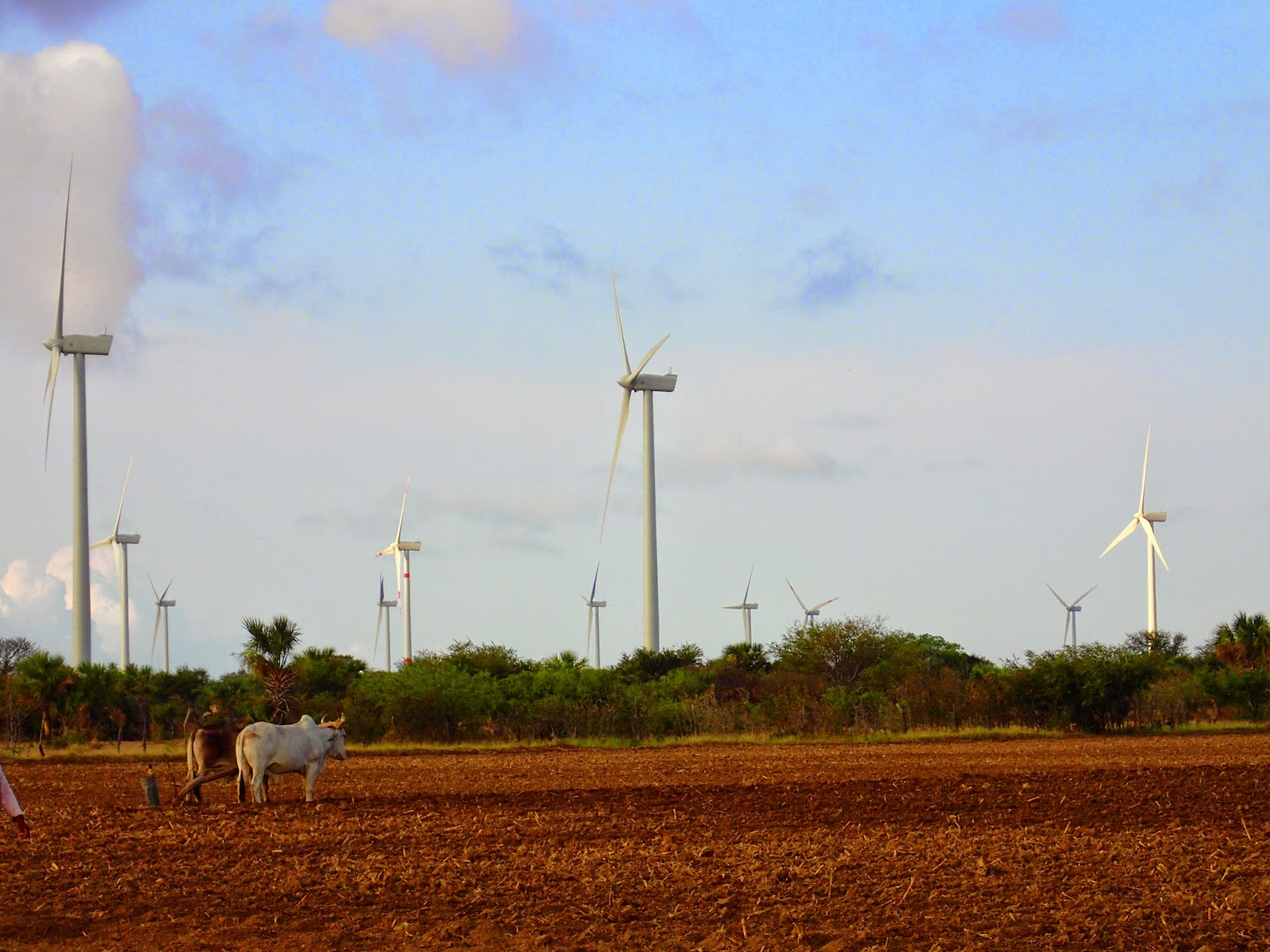
After an extremely hot morning in the fields we returned to our air-conditioned hotel rooms to relax and stay out of the heat. We all meandered through the central city market for lunch and later some of the group headed to a swimming hole to cool off.

Next week, you will hear about the end our trip in Juchitan and the remainder of our studies around tropical farming and gardening.

Adios for now!


Julianna and Nina

Thursday, March 19, 2015

Part 1: Food Systems

Buenas noches friends and family!


The past few weeks, Food Systems students have been traveling through the pueblos of Oaxaca, learning to cook from the pros, and of course, eating a lot (or what we like to call it, "quality control").  After our week of online courses, a UVM Anthropology and Food Systems professor, Dr. Teresa Mares, was able to visit Oaxaca to teach her course during UVM's Spring Break week.  This part of the course, titled Migration, Culture, and Cuisine, was focused on the connection between food and culture and how food can be a way to describe certain cultural traditions and social relationships.  By "intentionally hanging out" at three different markets in Oaxaca, purchasing ingredients from each, observing social relations at markets, building a glossary of common Oaxacan ingredients, conducting taste tests, and recording our observations, we became more familiar with the social importance of food, cooking, and consumption.  Our readings were particularly informative; we learned a bit about the history of Mexican cuisine and how it has come to include an evolving set of ingredients and influences, rather than an unchanging list of common dishes.
Rosie making the foam of Tejate

 One of our favorite field trips with Teresa was visiting Huayapam, a small town about 15 minutes outside of the city.  There we learned how to make a Oaxacan beverage that dates back to pre-Hispanic times called Tejate.  A mixture of roasted cacao, corn dough, and flor de cacao, this unique combination is topped off with a hand-whipped foam that indicates the quality of that batch and the talent of the tejatera.  We helped to roast and shell the cacao beans, grind them on a traditional metate, and watch in amazement as Rosie used her hands, cold water, and gravity to create the foam.  After, we even got to help make homemade pizza in a wood-fire oven for lunch!

The next week, we transitioned from Teresa's class to Dr. Cynthia Belliveau's.  During this part of the course, we are concentrating on actual cooking processes and observing the way that traditional recipes are made.  After finishing a final exam for Teresa's class, we had a closing comida at La Olla restaurant in the city and discussed how the different parts of this one course intersect.


Harvesting peas at Capulalpam
Later that week, we practiced our chopping skills with Cynthia and learned how to really cut an onion! It is a much more specific practice than one might think.  This past weekend, all of the Food Systems students, plus Cynthia and the Assistant Program Director Claire, traveled up to Capulalpam de Méndez (Pueblo Magico, the entire group visited this pueblo at the end of January) to observe an incredibly talented Oaxacan cook, Doña Tecla.  After making a quick snack of memelas, we set out to work on making Mole Verde.  The first steps of this process were harvesting and shelling peas from the fields behind the house, then the cooking began! It took the entire afternoon to make this flavorful dish, and it was accompanied with chicken, rice and fresh tortillas.  We all enjoyed the fruits of our labor (and Doña Tecla's talent) together in the late afternoon.  Later that evening, we took roasted cacao to the local mill and made chocolate! We tried our artistic skills by shaping the still-warm chocolate into all sizes.  The next morning, we were able to have one more "lesson" before we headed back to the city.  With the leftover mole from the day before, we made empanadas for breakfast with fresh tortillas.  We were sad to leave the beautiful, quiet pueblo (and the amazing fresh tortillas), but were happy to be back in the city and are ready to start our week of cooking class with Cynthia!
chocolate shapes


Some of the ingredients for Mole Verde
Making empanadas with Doña Tecla


Next week, we will update you on our progress of learning from some of the best local cooks!
~Kristina 

Wednesday, March 18, 2015

Botany Week 3


After taking our field final exam in the Sierra Norte for Botany, we arrived back home Sunday afternoon. After we returned we took two days off for some well deserved rest! I know that the vast altitude change knocked me out for a day! Later in the week, we wrapped up the class with an overview of the Iconic plants of Oaxaca.


 For our final class together we took a tour of the famous Ethnobotanic Gardens, next to the Santo Domingo, and saw different native and naturalized species of the state of Oaxaca. It was exciting to feel familiar with many of these plants after our trip. It was kind of cool to not feel like a complete tourist on the tour. Half the time I knew what the tour guide was going to say before she said it! As indicated by its name, the Oaxaca Ethnobotanic garden emphasizes not only teaching about the botany of the species of this region but also of the traditional uses of these plants. On our trip around the state, we learned primarily the botanical information about these species and how to identify them. In this tour, we learned about many fascinating traditional uses for many of these plants!


This week was also dedicated to our final paper for the Botany course. Each of us chose a topic (related to botany) and conducted research. I chose to study Cyperus rotundus, a problematic tropical weed that interferes with agricultural production in many parts of the world. I found interesting information about the biology of this plant and about the integrated management practices that are used instead of chemical herbicides. After last Friday we said our good-byes to our professor and prepared for our music class.


-----Amalia and Bobby

Global Health: Internships Week 2

Hola amigos! After a weekend of rest Shana, Cara, Spencer, and us, Heather and Elyse were ready to get back to our internships and learn more about health care in Oaxaca! Shana, Cara, and Spencer returned to the HIV/AIDS Health Clinic in san bartolo coyotepec about 20 minutes away. Shana and Spencer continued working on the promotion and education side of things by handing out condoms and information packets around the city and creating "memes" that educated the public on the importance of proper condom use. Cara worked alongside a nutritionist in the clinic advising patients on their diet and how to stay healthy with HIV.
One of the Meme's Shana and Spencer made


Heather and one of the horses!

Heather continued her internship at Fundacion Oaxaqueña Equinoterapia working with physically and mentally challenged children and adults to improve their gross motor and behavioral skills through horse therapy. 


Lauren on the right lecturing to the midwifery
 students at Luna Llena
Heather and Elyse at the Health Clinic
Elyse was able to attend two classes given by her mentor, Lauren, who is a midwife here in Oaxaca. Lauren is originally from California but moved down to Oaxaca 12 years ago and hasn't been able to leave (something we can all understand)! She now practices as a partera (midwife), promotes midwifery and women's health education, and give classes at the only midwifery school in Oaxaca, Luna Llena. Tuesday's class was from 4-7 and talked about the first physical exam given to expectant mothers from head to tow. After the lecture the midwifery students and Elyse split up into pairs and practiced performing an examination! The second class on Friday was an overview of STI's and interpreting labs. The students at Luna Llena come from all over Oaxaca and some were even from out of state. The girls meet for one week every six weeks for classes and in three years are certified parteras. They were all extremely friendly and welcoming to Elyse... as most people are here! 

On Monday and Wednesday Heather and Elyse visited a public health clinic near Xoxocotlan. On Monday after traveling about a half hour on bus we made it to our destination and were quickly put to work on creating a poster promoting vaccinations for perros (dogs) to prevent the transmission of rabies from dogs to humans. We were quite surprised with our artistic skills and were proud to hang it up in the waiting room of the clinic! We then spent the rest of the day following around a couple of med students and observed as they gave a lecture on preventing and curing diarrhea to some of the people waiting for their appointments. Wednesday was an even more exciting day.  Elyse and others spent the day walking to the houses of pregnant or postpartum mothers near the clinic. The purpose was to inform these women of the risks of pregnancy, specifically preeclampsia, and warning signs of when there is a need to head to the hospital, all in hopes of lowering the number of preventable maternal deaths. We visited four houses in total and then headed back to the clinic to observe pediatric vaccinations before we jumped on the bus back home.

On Friday we again all met up for a delicious Oaxacan comida at Oliver's brother-in-laws restaurant to debrief the week and all left with very large food babies. Once again a successful week for the Global Health track! 

Hope you enjoyed!
Elyse and Heather

Monday, March 9, 2015

Arts and Sciences Week 1

CHAMACOS! MIRA! We’re about to recount the adventure of the last few weeks of adventures with Michael Sundue as our professor. We started off our Botany of Oaxaca class last Monday at 9am in Solexico, where we used to take our Spanish classes. The class is small, only 4 of us! (Amalia, Bobby, and us, Caroline and Madeleine). Every day, we had class from 9-1 and then a lab activity in the afternoon, either on our own or with Michael. The labs involved trips to the market to pick out 10 different types of fruits or vegetables and dissecting them to identify what kind of plant they were and what part of the plant we were using. We learned that ginger isn’t actually a root, it’s a stem. And Squash and Eggplant are fruits, not vegetables! And Avocadoes are berries, but strawberries are not berries. Did you know that a pineapple isn’t just one fruit, but a collection of fruits? During class, some of us were having fun with using beets and turmeric root to draw with, too!


We embarked on our big journey last Monday morning from Conzatti Park. Along with our class, we had a few others join the caravan: Goyo, our stellar driver; Rayo, who spoke Zapoteco, an indigenous language; and Claire, our Assistant Director. Michael told us that Conzatti immigrated to Mexico from Italy, started a college, and was an expert in the flora of Oaxaca.

On the bus ride, Michael would scream “CHAMACOS! MIRA!” about every ten minutes, pointing out an interesting botanical fact about the road we were driving on. We didn’t get much sleep. Our first destination was Capulálpam, a Pueblo Magico where we had been before and were happy to return. As Michael said, a lot of us feel like Capulalpam is our “soul home of Mexico”. In Capulalpam, we ate at Doña Tecla’s house, where we had stayed last time. She makes scrumptious tortillas, some of the best we’ve had in Mexico! This trip was full of tortillas, especially for those of us who prefer to not eat meat. Many of our meals throughout the journey consisted of beans and tortillas, and we also had our fair share of hot chocolate.


 On our second day, we got to see a rain shadow in action- the divide between a dry climate and a wet climate. Clouds approach a mountain, but cool and condense instead of crossing over, creating a notable difference between the types of plants that grow on either side. Later that day, we descended in to the cloud forest, arriving at a waterfall where we took an hour to learn about ferns. That night, we settled in to our new home for the next three nights, “La Esperanza”. The air was so humid that the floor of our cabins were wet! There was a small restaurant in the town called “Comedor Lulu” where a little boy named Jonathan hung out. He was about 7 and loved talking to “el botánico” and shining his “mini laser” on us. During our time at La Esparanza, we went on lots of hikes. One day, we walked down a road (and cut down some sugarcane to eat along the way) and ended up at a river where we took a refreshing swim (it was hot!). However, the swim was cut short because it started to rain and we wanted to drive up the mountain before the dirt road got too wet to drive on. From that point on, it didn’t really stop raining.


Our last stop was Yetla, a pueblo alongside of a river. The whole town was basically a tropical botanical garden. We went on a hike led by Simón, a guide who knows a whole lot about plants and their medicinal uses. It was interesting to get his perspective alongside Michael’s perspective on the plants along the trail. On our last full day in Yetla, we had our field final. Michael collected 38 plants and gave them each a number, and we had to identify the latin name of the family of the plant. Some of the plants we had never seen before! The final was a challenge (especially because there was a baptism playing very loud bad music outside of the cabin) but we all did pretty well! Afterwards we had a lovely dinner all together. Our group got along well and had fun learning, sometimes we would have lecture in our cabins at night and we got to be in our beds. The class was unique from other classes that we have taken at UVM because it was so small, so hands on, and we got to spend time together in and out of class. We all agreed that it was one of our favorite classes that we’ve taken, and that we learned a lot. We’re looking forward to our final week of Botany in the city!

~ Caroline and Madeleine

Sunday, March 8, 2015

Global Health Week 1


Hola familias y amigos!


We hope you’ve been enjoying our weekly updates.  Shana and Cara here, reporting on our first week in the Global Health track.  We started our tracks with a week of formal classes with Oliver, Skyping in with Burton Wilcke, professor of global health from UVM.  We discussed multiple issues surrounding climate change, vector-borne diseases, migrant health, and the built environment.  It was muy interesante to learn about all the different factors that contribute to global health while being immersed in the Oaxacan culture.  After our classes everyday, we were privileged to go on various excursions around the area related to the health field.

On Monday, we visited an NGO that provided nearly every aspect of health care to low-income people in Oaxaca.  We took a tour of their facility and it was interesting to see that they had hospitalization services, gynecology, pediatrics, ophthalmology, psychology, and much more.  On Wednesday, we visited a governmental HIV/AIDS clinic in San Bartolo Coyotepec, about 30 minutes outside of the city.  It was a great experience to see how the community and government are working together to provide education, outreach, diagnosis, and treatment for this stigmatized disease.  Some of us will be interning for this clinic for the next 3 weeks, working on different sectors of their organization including nutrition, communication, and outreach for sexual diversity. 

On Thursday we received a presentation on Seguro Popular, a public health insurance provided to people who do not qualify for federal health insurance.  Health care is considered a human right here in Mexico so it was amazing to learn about different systems of health care services that cover all people of different classes that we do not see in the U.S.  Friday we visited Casa de la Ciudad, an organization that works on and promotes sustainable city landscape and design in Oaxaca.  It was extremely important to learn about the efforts that are taking place in order to create a more green and eco-friendly city.  This includes bigger sidewalks for pedestrians, bike paths, abundant reciprocals for trash and recycling, and solar panels.  We all felt really hopeful about the future of Oaxaca and city planning in general after this visit.  Friday afternoon we went to a clinic that promotes education and awareness about Dengue fever in Oaxaca.  It was interesting to learn all of the details of this disease as well as the efforts that are being made to reduce its occurrence.  At the end, we were presented with certificates for attending the program- it was stellar.  All in all, week 1 of Global Health was a success.  This week we are starting our internships and are extremely excited to experience first-hand how health care and public health issues are carried out in this wonderful city. 
Hasta la pasta,

Shana y Cara

Week 8: Back to Work!

¡Saludos todos!

 We returned from our voyage to Puerto Escondido with sunburns and smiles on all our faces, feeling refreshed and ready to face the new week and our new classes. Monday was the start of our tracks, where our unified group split off into three different specializations: Arts & Science, Global Health, and Food Systems. Our professors arrived from Vermont throughout this week. Those in Arts & Sciences started a botany class taught by Michael Sundue in order to learn about the many plant species that grow here in Oaxaca, while Global Health began a class taught by Oliver and Burt Wilke. The Food Systems track started off at a different pace, as our first week's classes were entirely online. We participated in an online discussion about food and culture in Mexico, but this also gave us free time to work on our Independent Study Projects, as well as to explore the city and visit landmarks we might have missed.


Some of us took a few hours to see the Stamp-collecting museum (Museo Filatelia de Oaxaca), a charming place with a huge collection of stamps around the world -- including the "Penny Black", the first stamps ever made! The city of Oaxaca is full of small, wonderful places like this one, and all it takes is a little curiosity to discover something wonderful.
Later on in the week, some students in the Food Systems track paid a visit to CEDICAM in Nochixtlán, about a 1.5-hour bus ride outside of the city. There, we learned about local initiatives to replenish and reforest land that had been severely eroded in the past. We met with Phillip, who told us about all the techniques the local campesinos have used to restore the land and support their community, and we talked about how we can make sustainable choices in our own lives and communities. We left the meeting feeling inspired to make a positive change.

Lastly, Sunday the 21st was our Teacher Assistant Claire's birthday. Following a tip from her brother, we clandestinely organized a surprise party to celebrate, and brought two cakes: one chocolate, the other coffee flavored. The surprised joy on her face was priceless!

Next week, our tracks will really get into gear, as the Botany track is taking a visit to the mountains while Global Health begins their internships. Food Systems is starting their in-person classes, as well as taking field trips to markets in Oaxaca, Etla, and visiting kitchens all around the city. Things are really getting exciting!

We hope you enjoyed this week's update! ¡Que tengas un buen dia!


Until Next Time,

Charlotte and Rose